

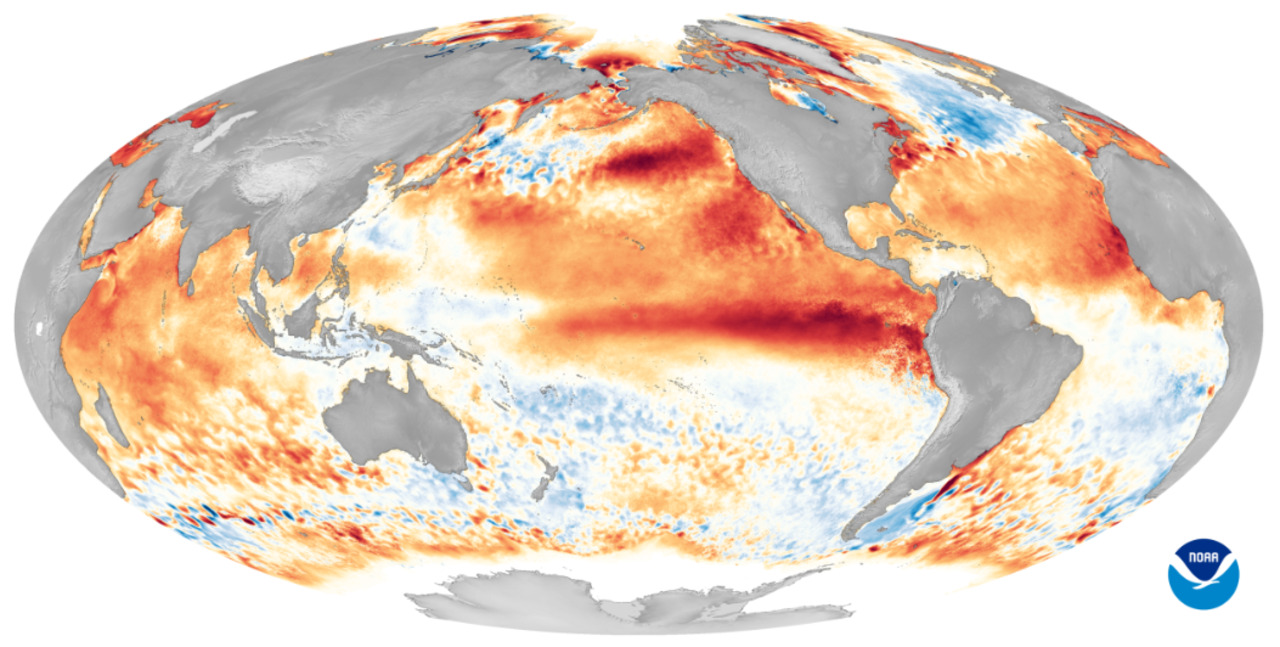
As El Niño returned in 2023 after several years of La Niña, federal climate forecasters said the Pacific pattern was likely to shape winter weather across large parts of the United States. In its winter outlook released Oct. 19, 2023, NOAA said the event was expected to strengthen through the season and could rank among the stronger El Niño episodes observed since modern records began in 1950. The forecast pointed to a winter with heavier precipitation in the South and increased mountain snow potential in parts of the West, while much of the northern U.S. was favored to be warmer than average.
NOAA’s winter outlook put a strong El Niño at the center of the forecast
NOAA’s Climate Prediction Center said on Oct. 19, 2023, that El Niño was in place heading into winter for the first time in four years, and the agency tied that pattern directly to its national temperature and precipitation outlook. According to NOAA, the strongest signal in the forecast favored above-average temperatures across the northern tier of the continental United States, including the Pacific Northwest, Great Lakes and parts of New England.
The agency’s precipitation outlook showed increased odds of wetter-than-average conditions across much of the southern United States, stretching from California across the Gulf Coast and into parts of the Southeast, according to NOAA’s winter release and Climate.gov analysis. NOAA also said the atmospheric setup could support heavier mountain snow in parts of the western U.S., even as lower-elevation snowfall outcomes remained more variable.
Federal forecasters stopped short of saying any one storm or region was guaranteed to see flooding or major snow events. Instead, NOAA framed the outlook as a probability-based seasonal forecast, meaning El Niño raises the odds of certain broad patterns but does not determine every local outcome. That distinction matters because strong El Niño winters have historically shared some common features, but individual storms still depend on shorter-term weather conditions.
For the southern tier, NOAA said the clearest signal was an increased chance of above-average winter precipitation, a pattern that often brings more frequent storm tracks across the region. That includes parts of California, the Southwest, the Gulf Coast and the Southeast, where El Niño winters have historically leaned wetter than normal, according to NOAA Climate.gov’s review of the seven strongest events since 1950.
In the West, forecasters said the greatest snow-related effects were most likely in higher elevations where temperatures stay cold enough to support snow instead of rain. National Weather Service regional outlooks published alongside the broader forecast said El Niño can enhance the potential for significant mountain snowfall, particularly when Pacific storms repeatedly move inland. The exact placement of those storms, however, was not yet known when the seasonal outlook was issued.
What remained uncertain was how evenly those precipitation totals would be distributed and whether individual communities would see beneficial snowpack, flooding rain, or both. NOAA did not release a storm-by-storm breakdown because seasonal outlooks are designed to show the most likely three-month pattern, not specific local events. For residents, that meant a higher seasonal risk in some regions, but not a precise prediction for any single county or city months in advance.
El Niño develops when sea surface temperatures in the central and eastern equatorial Pacific rise above average and alter the jet stream, changing temperature and precipitation patterns far from the tropics. NOAA formally declared El Niño conditions in July 2023 and said at the time that the event was expected to gradually strengthen into winter. By November, the Climate Prediction Center said there was better than a 55% chance that at least a strong El Niño would persist through January to March 2024.
NOAA’s historical analysis showed that the strongest El Niño winters since 1950 were often associated with wetter conditions along the southern tier and parts of the West Coast. That history is one reason forecasters emphasized heavy rain and mountain snow potential in the 2023-24 outlook, while also warning that not every strong El Niño produces identical outcomes from one state to the next.
For households and local officials, the practical message was that winter planning needed to account for elevated precipitation risk in the South and possible major snowpack swings in western mountains. NOAA said its Weather Prediction Center and Climate Prediction Center would continue issuing winter key messages as the season evolved. The agency’s outlook left room for change at the local level, but it made clear that El Niño was expected to be the dominant driver of the 2023-24 winter pattern.