

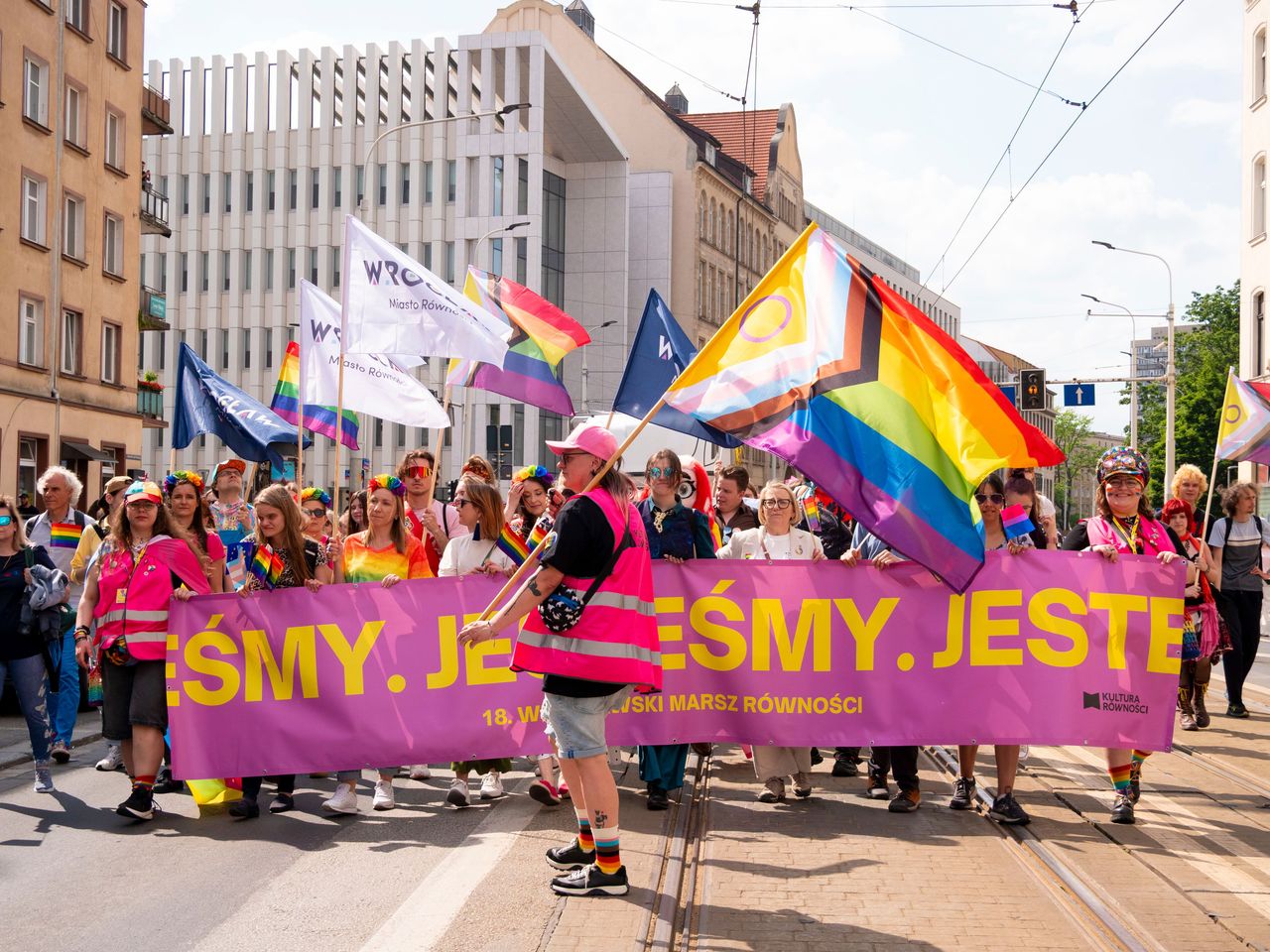
Pride Month opened this year with a warning sign. A new Gallup survey suggests the long arc of rising public support for LGBTQ rights in the United States is no longer moving in a single direction.
The new Gallup numbers show a real retreat from recent highs

Gallup’s latest findings, published June 3, 2026, make clear that support for core LGBTQ issues remains broadly positive by historical standards, but it has weakened from the peaks reached earlier this decade. According to Gallup, 64% of Americans now say same-sex marriage should be recognized as valid by law, down from the record 71% measured in 2022 and 2023. A separate measure found 68% of Americans say gay or lesbian relations are morally acceptable, down from 74% in 2022. On transgender issues, the shift is even more striking: about 4 in 10 Americans now say changing one’s gender is morally acceptable, down from nearly half in 2021.
That matters because Gallup is not showing a collapse in support so much as the end of a long period of steady expansion. In the mid-1990s, backing for same-sex marriage was a minority position. By 2011, the country had crossed a symbolic threshold when support edged into majority territory. The years that followed brought continued gains, culminating in a powerful sense that public opinion had settled. What Gallup now shows is that those gains were not immune to reversal.
The Associated Press, which reported on the findings as Pride Month began, noted that acceptance of same-sex marriage and relationships has flattened after more than two decades of growth. That description is important. Flattening can be the stage before stabilization, but it can also be the stage before decline becomes normalized. In this case, Gallup’s own trend lines suggest the country has already moved beyond a plateau and into a measurable retreat.
Even so, perspective matters. A majority of Americans still support legal recognition for same-sex couples, and most still say same-sex relations are morally acceptable. The political and social landscape of 2026 is far more supportive than the America of 2004 or 1996. But the poll is significant precisely because it captures a backward movement during a period that many advocates once assumed would continue to bring forward momentum.
The decline is not uniform, and that is part of the story

The topline numbers only tell part of the story. Gallup’s trend reporting has repeatedly shown that partisan division is now one of the most powerful forces shaping attitudes toward LGBTQ issues, and the latest findings fit that pattern. Democrats remain overwhelmingly supportive on same-sex marriage and moral acceptance of gay and lesbian relations. Independents also remain relatively supportive, though less uniformly so. Republicans, however, have moved sharply in the opposite direction over the last few years.
That partisan sorting changes the meaning of the overall decline. This is not a case of the entire country moving together toward a more skeptical stance. It is a case of one segment of the electorate hardening against LGBTQ causes while the broader consensus becomes more brittle. In practical terms, that means national majorities can coexist with much more intense opposition in states, school districts, legislatures, and courts. Public opinion can remain favorable in aggregate while becoming more combustible in everyday politics.
There is also an important distinction between views on gay and lesbian rights and views on transgender issues. Support for same-sex marriage has slipped, but it still stands on much firmer ground than transgender acceptance. Gallup’s finding that only about 40% of Americans see changing one’s gender as morally acceptable points to a much more unsettled area of opinion. That gap helps explain why political debate has increasingly centered on trans participation in sports, youth healthcare, school policies, and identification documents rather than on same-sex marriage itself.
Generational change, once seen as the engine of inevitable liberalization, also looks more complicated than many assumed. Gallup has separately found that LGBTQ identification continues to rise, especially among younger adults, with Gen Z reporting the highest rates by far. Yet higher identification does not automatically produce stable consensus across every issue. Younger Americans are more supportive overall, but they are also living in a hyper-polarized media environment where social values are argued over constantly, often in absolutist terms.
The result is a country with overlapping realities. In one, LGBTQ visibility is greater than ever, same-sex marriage is legal nationwide, and younger generations are reshaping cultural norms. In the other, support is softening, partisan identity is driving moral judgments, and gains that once looked permanent now appear more conditional.
Why support is slipping now

Any single poll can show movement for several reasons, but the broader context makes this decline easier to understand. Over the past several years, LGBTQ issues have become central to the culture war, especially questions involving transgender Americans. Republican officeholders, conservative advocacy groups, and allied media outlets have invested heavily in framing debates over gender identity as concerns about fairness, parental rights, child protection, and institutional overreach. Those frames have proved politically potent.
The legal environment has amplified that dynamic. Since 2021, states across the country have advanced or enacted measures affecting transgender youth healthcare, school policies, bathroom access, pronoun use, and sports participation. At the same time, court battles have kept these topics in the headlines, often turning highly personal questions into national political flashpoints. The sheer repetition of these conflicts matters. Constant exposure can shift attitudes even when underlying support for equality remains intact in principle.
There is also a broader backlash pattern that often follows periods of rapid social change. The United States moved quickly on LGBTQ acceptance in the 2010s, especially after the Supreme Court’s 2015 decision recognizing same-sex marriage nationwide. For many Americans, that shift came to feel complete. But social progress is rarely linear. Once a movement becomes associated with contested questions about schools, sports, medicine, religion, and compelled speech, people who supported one form of equality may hesitate on another.
Religion and ideology also continue to shape public opinion. Recent reporting from the Associated Press on other Gallup findings has highlighted renewed religious intensity among some young men, at the same time that partisan identity increasingly overlaps with moral worldview. That does not automatically translate into anti-LGBTQ sentiment, but it can reinforce more traditional positions on sexuality and gender, particularly when those positions are presented as a defense against cultural instability.
Perhaps most importantly, the decline reflects how issue bundling works in modern politics. Many Americans may still support a gay neighbor, a lesbian family member, or the legal right of same-sex couples to marry. Yet when LGBTQ issues are discussed through the narrow lens of youth gender medicine or school disputes, the entire category can become politically re-coded. The Gallup poll suggests that for some Americans, attitudes about one contested set of issues are now dragging down support across the broader LGBTQ landscape.
What this means for politics, policy, and daily life

A cooling in public support does not simply remain a polling story. It changes the incentives for politicians, advocacy groups, employers, school systems, and courts. When support appears to be rising, institutions are more likely to move ahead confidently with inclusive policies, believing public opinion will broadly sustain them. When support softens, even if majorities remain favorable, decision-makers become more cautious and more reactive to organized opposition.
That is especially true in state politics. National majorities can mask the fact that power is often exercised locally. A legislature in one state does not need national backing to restrict healthcare access for transgender minors, alter school guidance on gender identity, or limit discussion of sexuality in classrooms. If elected officials believe the public mood has shifted, even modestly, they may feel emboldened to act more aggressively. Polling changes can become policy changes long before they register as a sweeping national transformation.
For LGBTQ Americans, the consequences are personal as much as political. Gallup has separately tracked how Americans view the nation’s acceptance of gay and lesbian people, and those perceptions shape everyday life in ways that are hard to quantify. A decline in abstract moral acceptance can filter down into workplaces, schools, families, and neighborhoods. It can influence whether people feel safe being open, whether companies celebrate Pride publicly, and whether local institutions choose visibility or retreat.
The timing also gives the poll symbolic force. Pride Month has long served as both celebration and assertion: a reminder of progress, but also of the need to defend it. A report showing support slipping at the very start of June inevitably reframes the month’s mood. Instead of asking how far the country has come, it pushes a harder question into public view: how durable was that progress in the first place?
That does not mean a new consensus against LGBTQ rights has taken hold. It means the era of assuming that public opinion would continue improving on its own is probably over. Future gains, and even the preservation of existing ones, may depend less on demographic destiny and more on persuasion, coalition-building, legal defense, and the ability to separate broad human dignity from the most politically explosive edge cases.
The country is not returning to the past, but it is losing confidence in the future

It would be a mistake to read the Gallup poll as proof that America has reverted to an earlier era. Same-sex marriage remains legal nationwide, most Americans still support it, and public visibility for LGBTQ people is deeply embedded in national culture. Major corporations, entertainment industries, many religious communities, and large parts of civil society have changed in ways that are unlikely to be completely undone. The country of 2026 is not the country of 1996.
But it would be an equal mistake to dismiss the findings as statistical noise. Polling shifts matter when they align with broader political and cultural signals, and this one does. The United States is in a period of ideological hardening, and LGBTQ issues are now caught inside that larger struggle. The movement is no longer benefiting from the same tailwind of expanding consensus that defined much of the previous decade. It is operating in a more defensive posture, especially on questions involving transgender rights.
That change carries lessons for advocates and for the broader public. One is that legal victories do not settle cultural disputes as fully as they sometimes appear to. Another is that public support is not a one-time achievement. It must be maintained, argued for, and translated into lived familiarity. People often support rights most firmly when they understand the humans involved, rather than the slogans or controversies built around them.
There is also a lesson about political storytelling. For years, the dominant narrative was that the country was steadily becoming more accepting and that opposition would fade through generational replacement. Gallup’s new poll complicates that story. Progress can stall. It can fray at the edges. It can even move backward without disappearing entirely. That is a more unsettling reality, but also a more accurate one.
The significance of this year’s Pride Month poll lies in that tension. America has not abandoned LGBTQ rights, but it has become less certain, less generous, and more divided about what those rights mean. That is not a dramatic collapse. It may be something more difficult: a slow erosion of confidence at the very moment many people hoped the debate had already been settled.