

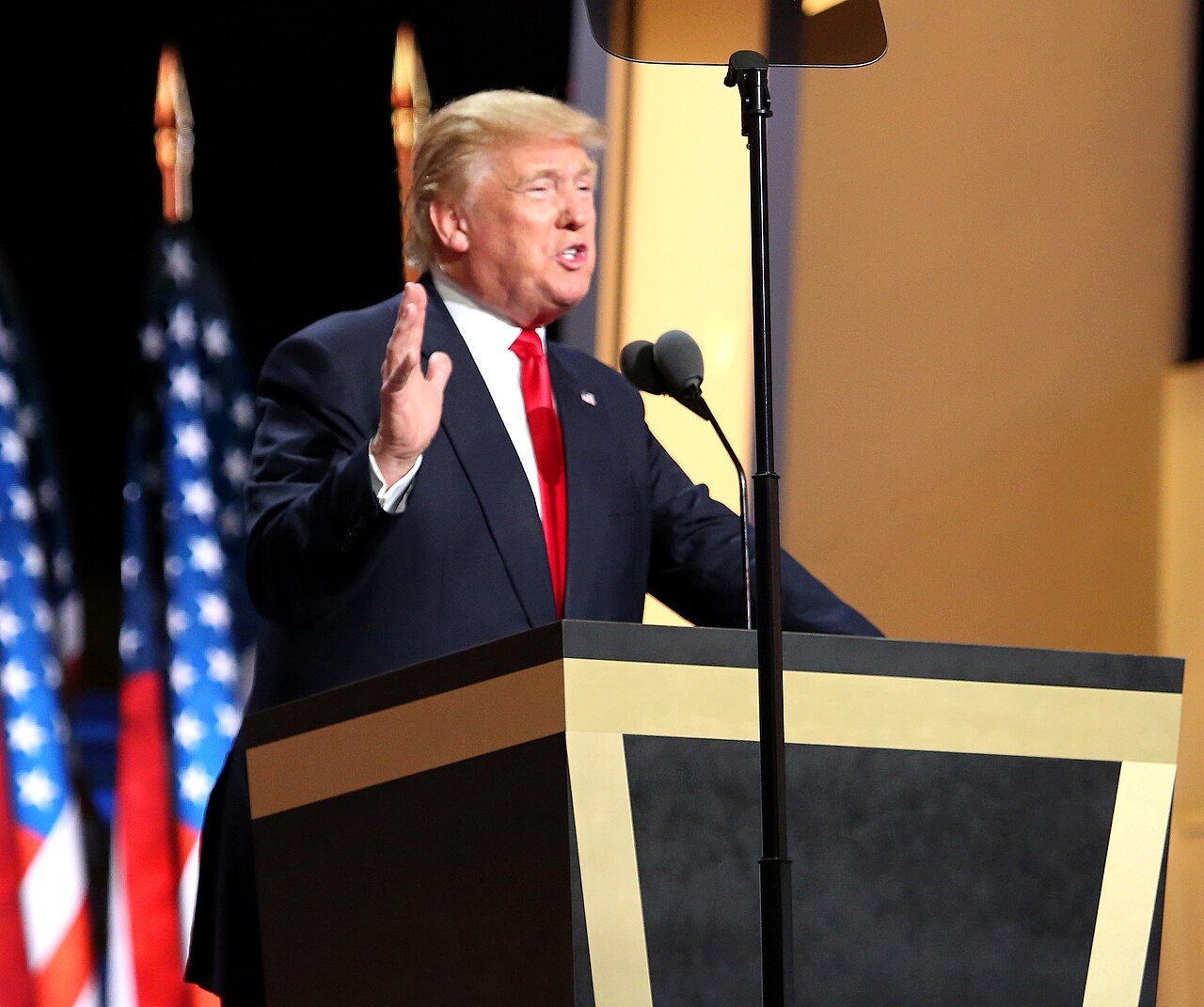
President Donald Trump’s latest economic promise has quickly become a legal and political flashpoint in the 2026 midterm campaign. In a speech in Dallas on September 9, Trump said he would send every adult U.S. citizen a $5,000 “dividend” if Republicans keep control of both the House and Senate. The proposal immediately raised questions about whether a cash promise tied to an election crosses into prohibited vote-buying, even as legal experts say the answer is not straightforward.
Trump ties a nationwide cash pledge to the midterm outcome
Trump made the pledge during the opening night of the Republican midterm convention in Dallas, according to the Associated Press and Reuters. He said he would “issue a dividend” of $5,000 to every adult citizen if Republicans win both chambers of Congress in November. Based on estimates cited by AP, the proposal could cost more than $1.3 trillion if applied to roughly 270 million adults.
The White House did not release a detailed written policy alongside the speech, and no legislative text had been introduced as of the immediate aftermath of Trump’s remarks. Reuters reported that legal scholars and election-law specialists were examining whether the structure of the promise could create problems under federal anti-bribery and vote-buying rules. Those laws generally bar giving or offering something of value in exchange for voting behavior, but experts told multiple outlets that Trump’s offer may fall into a gray area because it was framed as a universal payment rather than an individual reward for casting a ballot.
That distinction has become central to the legal debate. Coverage from Reuters, AP and other outlets said some experts viewed the proposal as politically extraordinary but not an obvious criminal case, because the money was not explicitly conditioned on a person proving they voted or voted a certain way. Even so, the fact that Trump linked the payout to an election result has kept bribery questions at the center of the discussion.
Because Trump described the payment as a benefit for every adult citizen in the United States, the direct reach of the proposal would be nationwide rather than limited to one state or region. What is confirmed is the basic promise made in Dallas on September 9 and the broad scale of the proposed payout. What is not yet known is how eligibility would be verified, how the spending restriction Trump mentioned would be enforced, or whether the administration has any formal mechanism to deliver the payments without congressional action.
That uncertainty matters because the Constitution gives Congress the power of the purse. AP reported that budget experts and lawmakers from both parties questioned whether a president could send checks of that size without new legislation. Reuters similarly reported that legal and fiscal analysts saw congressional approval as a major obstacle, regardless of how the election-law questions are resolved.
There is also no confirmed federal agency rollout, payment schedule or official cost estimate from the administration itself. Trump compared the idea to a prior military payment approved from already appropriated funds, but news reports noted that a national $5,000 program would be vastly larger. For residents, that means the proposal remains a campaign pledge, not an announced federal benefit with published rules.
The core legal question is whether a broad campaign promise can be treated like bribery when it is tied to an electoral result. Reuters reported that specialists in election law and former prosecutors said traditional bribery or vote-buying cases usually involve direct exchanges with individual voters. In this case, the promise was framed as a government payment available to all adult citizens if Republicans win, a structure some experts said makes prosecution less likely even if the language drew comparisons to an inducement.
A second issue is institutional rather than criminal. AP and Reuters both reported that Trump does not appear to have unilateral authority to create a program of this size on his own. Any payment on the scale described would likely require Congress to pass legislation or appropriate funds, which makes the pledge as much a separation-of-powers issue as an election-law issue.
For the public, the practical takeaway is that no checks are scheduled and no final legal judgment has been issued. What voters can expect for now is continued scrutiny from election lawyers, budget analysts and lawmakers as the campaign moves forward. The next concrete development would likely be either formal legislation, a fuller White House plan or additional guidance from administration officials about how the proposal is supposed to work.