

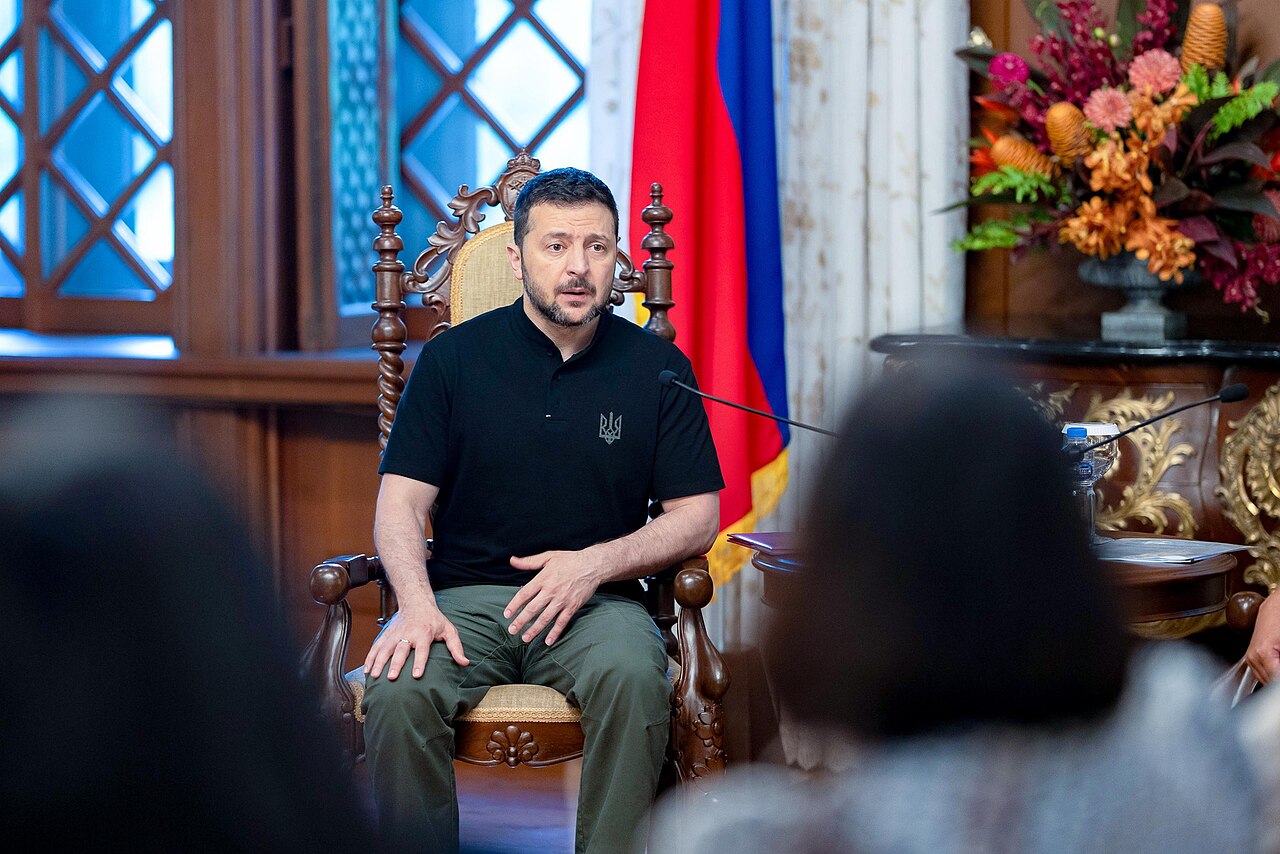
As the war in Ukraine enters another winter planning season, air defense and energy security have again moved to the center of U.S.-Ukraine talks. That focus sharpened in New York on September 22, when Ukrainian President Volodymyr Zelensky met President Donald Trump and then described a push for immediate winter support. The discussion comes as Trump has signaled that future backing for Kyiv will be tied more explicitly to what the United States receives in return.
Zelensky’s winter request centers on Patriot systems
Zelensky said he asked Trump for a “winter package” of military equipment ahead of the cold season, including Patriot anti-missile systems and related technologies, according to an interview he gave to The Wall Street Journal after their September 22 meeting on the sidelines of the U.N. General Assembly. Axios had previously reported in July that Zelensky was seeking an emergency package of Patriot interceptors to protect Ukraine’s energy grid before winter.
The scale of the request matters because Patriot systems remain among the few defenses capable of countering ballistic missile threats. Reuters reported in July that Trump said the United States would grant Ukraine a license to manufacture Patriot missile interceptors, describing it as a major step for Kyiv after repeated requests for greater access to the system. Zelensky later said a political agreement had been reached on those licenses, according to Reuters.
Trump has also made clear that approval of additional Patriot support does not automatically mean a transfer from existing U.S. stocks. CBS reported in July that Trump said the United States did not plan to give Ukraine more Patriots at that point because the U.S. needed the equipment itself. That distinction has left Ukraine pressing both for near-term deliveries and for longer-term production arrangements as winter approaches.
The practical stakes are highest in Ukraine, where officials have repeatedly warned that Russia could renew large-scale attacks on power generation, transmission and heating infrastructure during the cold months. In Zelensky’s July interview with Axios, he said Patriot interceptors were needed to head off what he described as a potential winter disaster tied to strikes on the energy system.
What is confirmed is that Trump and Zelensky discussed support for Ukraine ahead of winter and possible de-escalatory steps linked to energy infrastructure. In a statement released September 22, Zelensky’s office said the two presidents discussed steps that could open the way to diplomacy and support for Ukraine before winter. The White House also posted video of the bilateral meeting that day, confirming the encounter took place.
What is not yet known is whether the United States will approve a new transfer of Patriot batteries, provide only interceptors, or rely mainly on production licensing and allied coordination. Neither the White House nor Ukraine’s presidency has released a full public inventory of what could be included in any winter package. That leaves the timing, volume and delivery method of any Patriot-related support unresolved.
Trump’s position has increasingly tied Ukraine policy to transaction-based demands on allies and partners. Reuters reported on September 3 that Trump said he would ask European nations to pay back the United States for military aid and munitions previously sent to Ukraine. That approach helps explain why Zelensky’s request for Patriot support is unfolding alongside negotiations over burden-sharing rather than as a straightforward aid announcement.
The broader context is a U.S. administration trying to restart diplomacy with Russia while limiting new unilateral commitments. Axios reported this month that the Trump administration has explored winter de-escalation steps, including efforts related to attacks on energy targets and renewed talks. Zelensky has said he wants progress before winter sets in, while also arguing that pressure on Moscow must continue.
For residents in Ukraine, the immediate meaning is practical rather than rhetorical: air defense capacity will shape how well cities, utilities and heating systems withstand the next phase of Russian attacks. For U.S. and European officials, the next question is whether winter assistance will arrive as direct materiel, industrial licensing, or a package financed more heavily by allies. As of September 24, those details had not been publicly finalized.