

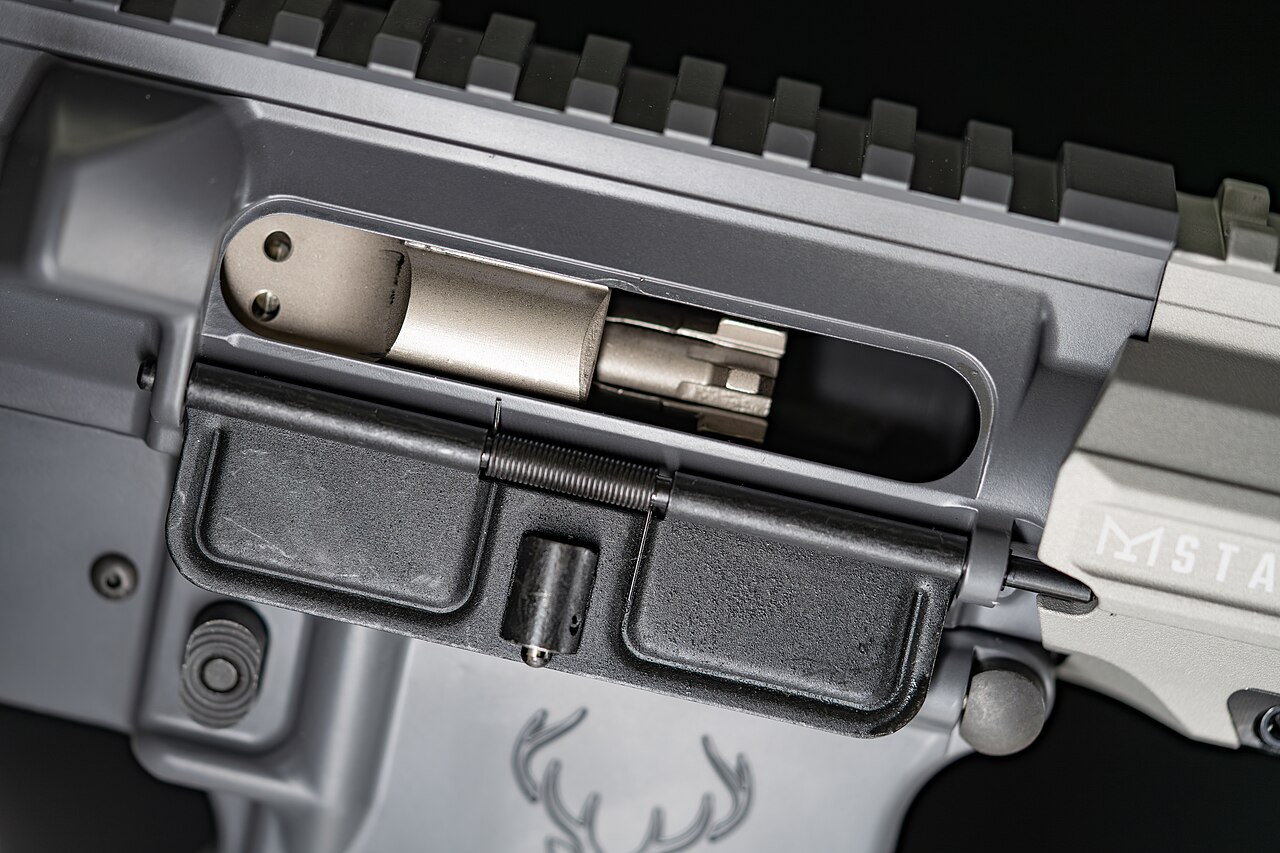
As the Justice Department expands its Second Amendment litigation strategy, AR-15-style rifles have become a central test of how the federal government argues that a firearm is in “common use.” The latest filing narrows that fight to a specific number — 94.5% — as DOJ and allied court briefs point to widespread police adoption of rifles similar to the AR-15. The argument matters nationally because it seeks to link civilian ownership rights to the routine equipment choices of American law enforcement.
DOJ’s latest filing puts “common use” at the center
The immediate event is a Sept. 4, 2026 amicus brief filed by the United States in a Supreme Court case over AR-15 bans, where DOJ argued that AR-15 rifles are widely possessed and therefore protected under the Second Amendment, according to the filing on the Supreme Court’s docket. In that brief, the government said the judiciary and executive branch have both recognized the ubiquity of the AR-15, citing prior Supreme Court language describing it as the most popular rifle in the country and referencing estimates that millions of Americans own one. The brief also cited production and circulation figures to argue that AR-15-style rifles are not niche firearms but a major share of the U.S. rifle market.
The 94.5% figure highlighted in the broader debate does not appear in the DOJ Supreme Court brief itself, based on the available filing. But related briefs and prior legal arguments have relied on policing data to make a similar point: rifles of this type are broadly used by law enforcement agencies, not treated as unusual weapons. A separate amicus brief filed Sept. 4 by firearms instructors and ballistics specialists argued that police often use AR-15-platform rifles in building searches and other close-range settings, citing accuracy and reduced overpenetration concerns compared with some handgun rounds.
That argument tracks the Justice Department’s recent posture in other cases. On May 5, 2026, DOJ sued Denver over its local weapons ban, saying AR-15-style rifles are among the most popular rifles in America and are owned by tens of millions of law-abiding citizens, according to the department’s public announcement.
For local readers, the practical takeaway is that the federal government is not only making a constitutional argument about civilian gun ownership; it is also using the standard equipment of police departments as part of that case. The most directly relevant federal dataset is the Bureau of Justice Statistics’ Law Enforcement Management and Administrative Statistics survey, which tracks weapons policies and equipment across general-purpose state and local agencies. BJS says the survey covers local police departments, sheriffs’ offices and primary state law enforcement agencies, though it excludes federal agencies and special-jurisdiction departments such as schools, airports and parks.
What is confirmed publicly is that police rifle use is widespread in national policing surveys. A 2013 Police Executive Research Forum survey of large agencies found that 93% of responding agencies equipped some officers with rifles or “assault weapons,” a figure that has been cited repeatedly in later gun litigation. But a full public federal table showing the exact 94.5% figure for all police departments was not identified in the available court and agency materials reviewed here, and DOJ has not publicly released a standalone explanation tying that precise percentage to one current nationwide source.
That distinction matters because court filings often draw from different datasets, different years and different agency types. A percentage based on large urban departments, for example, is not the same as one covering every municipal department or sheriff’s office in the country.
The broader context is the Supreme Court’s modern Second Amendment framework, especially the “common use” test that asks whether a weapon is commonly possessed for lawful purposes. DOJ’s Sept. 4 brief argued that the AR-15 is the “quintessential example” of a protected arm under that standard, relying on ownership estimates, domestic circulation figures and prior Supreme Court language. The department’s earlier Denver lawsuit used the same constitutional theory, saying bans on AR-15-style rifles burden arms in common lawful use.
Supporters of that approach have increasingly used police adoption data to reinforce the point. If agencies charged with responding to violent crime issue similar rifles to officers, the argument goes, those firearms are ordinary tools rather than exceptional weapons. The Sept. 4 amici brief from firearms trainers and ballistics experts advanced that logic directly, arguing that police use these rifles for accuracy, controllability and indoor response.
For residents, that means the legal fight is likely to keep focusing on how courts measure “common use” and what evidence counts most: consumer ownership, manufacturing volume, or adoption by police. As of Sept. 8, 2026, DOJ’s position is clear in its filings, but the precise sourcing behind the 94.5% figure remains less clear in public documents than the broader claim that police rifle use is widespread.