

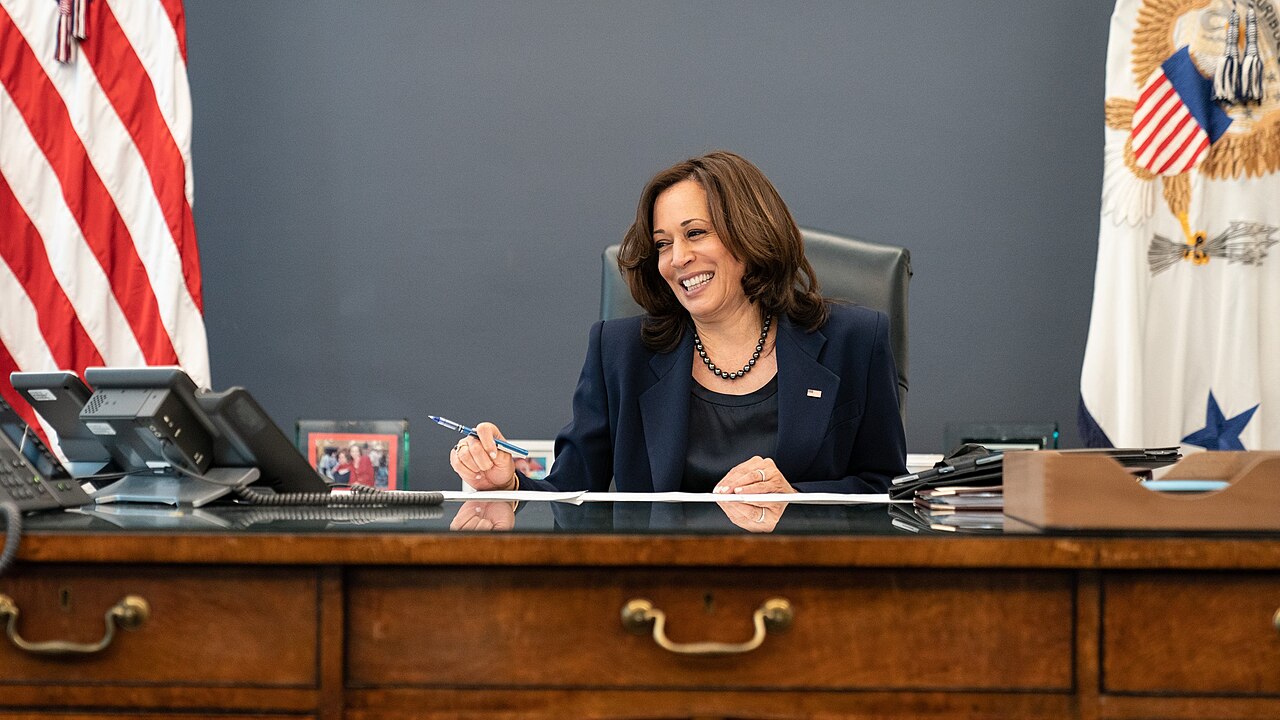
National polling is already shaping early expectations for the 2028 presidential race, even though no major-party nominating contest is underway and several possible candidates have not announced campaigns. Kamala Harris is now back in that conversation after a new Rasmussen Reports survey found her leading a hypothetical Democratic primary field, adding fresh attention to whether the former vice president could still become the nation’s 48th president. Harris has not launched a 2028 campaign, but her public comments and the latest polling have kept her among the most closely watched Democrats.
A new survey places Harris at the top of an early Democratic field
Rasmussen Reports said its latest national survey of likely Democratic primary voters, conducted August 2 through August 4, 2026, found Harris at 37% support in a hypothetical 2028 Democratic nomination contest. According to Rasmussen, that put her ahead of Rep. Alexandria Ocasio-Cortez, who polled at 15%, with other potential contenders trailing further behind. The poll became part of a wider political discussion because it offered one of the clearest snapshots yet of Harris’ standing in an early, unsettled field.
The survey does not mean Harris is the Democratic nominee, and it does not measure a general-election race in which a nominee would need to defeat a Republican candidate. Still, it is significant because Harris remains the highest-profile Democrat to have run nationally in the last presidential cycle. Her standing has also been reinforced by broader political coverage this summer that has continued to place her near the top of early 2028 Democratic rankings.
That attention has continued even though Harris has not made a final decision about another White House bid. Reuters reported in April 2026 that Harris said she was considering running for president again in 2028. The Associated Press separately reported in October 2025 that Harris said she was “not done” with public service and had not ruled out another campaign, keeping the question of her political future open.
Because the new poll measures a national Democratic primary, it does not show how Harris is performing in individual battleground states that would be central in either a primary calendar or a general election. No comprehensive public breakdown tied to this specific Rasmussen survey has been released for states such as Pennsylvania, Michigan, Wisconsin, Georgia, Arizona or Nevada. That means the state-level strength behind Harris’ national lead is not yet publicly confirmed.
The uncertainty matters because presidential nominations are decided through state contests, not a single national vote. Democratic officials are already looking toward the 2028 calendar, and Axios reported in July that the party’s preliminary choice of South Carolina for the first Democratic presidential primary added new strategic importance to early-state organizing. If Harris runs, her path would depend not only on national name recognition but also on how she performs where delegates are actually awarded.
For voters, the current takeaway is narrower than the headline. The polling shows Harris remains a serious figure in the Democratic conversation, but it does not establish how durable that support would be once rivals begin campaigning, fundraising and debating. It also does not answer whether Harris will enter the race at all, and she has not announced a formal candidacy.
The reasons Harris is polling strongly this early appear rooted in a combination of visibility, recent history and the absence of a settled Democratic alternative. As the 2024 Democratic nominee and a former vice president, Harris starts with national recognition that most other potential 2028 contenders do not have. That advantage often matters in very early polling, when many voters know one or two names far better than the rest of the field.
The Democratic Party is also still working through its post-2024 identity. The Associated Press reported in May 2026 that the Democratic National Committee’s postelection review criticized Harris’ 2024 campaign strategy, showing that debate over her strengths and weaknesses remains active inside the party. At the same time, those internal criticisms have not pushed her out of the early 2028 conversation, suggesting many Democratic voters still see her as a plausible national standard-bearer.
What Americans should expect next is more testing, not certainty. Additional national and early-state polls are likely to follow as potential candidates make moves ahead of the midterms and beyond. For now, the new survey offers a verified sign that Harris remains politically relevant at the highest level, but whether that translates into a formal campaign — and eventually a path to becoming America’s 48th president — is still unresolved.