

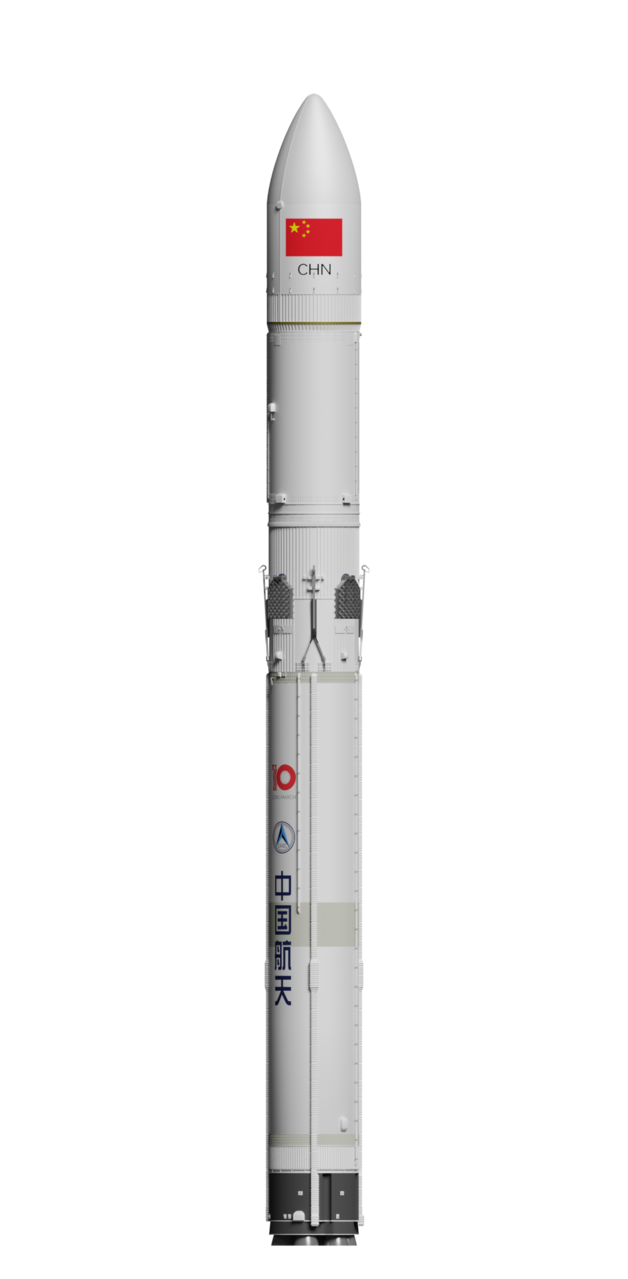
China’s space industry is moving deeper into reusable launch technology, an area that has helped U.S. companies sharply reduce launch costs and increase flight cadence. On July 10, China said it completed its first controlled recovery of a rocket booster with the Long March-10B, a milestone that state media and outside reports described as a breakthrough for the country’s launch program.
China says the Long March-10B completed its first controlled booster recovery
China Aerospace Science and Technology Corp., the country’s main state-owned space contractor, said the Long March-10B lifted off at 12:15 p.m. local time on July 10 from the Hainan commercial space launch site. According to the company, the rocket placed a satellite into its planned orbit before the first stage separated and began a return sequence about six minutes later.
The company said the booster made a vertical return and was recovered on a sea platform using a net-capture system. State media described it as China’s first successful controlled recovery of a carrier rocket booster, and China Aerospace Science and Technology Corp. said it was also the first time the country had completed this kind of reusable rocket recovery mission.
China Aerospace Science and Technology Corp. said the Long March-10B is a two-stage liquid rocket about 63 meters long, with liftoff thrust of roughly 890 metric tons and liftoff weight of about 760 metric tons. In its reusable configuration, the company said, the vehicle can carry 16 metric tons to low Earth orbit, a capability that positions it for satellite internet deployments and other commercial missions.
Associated Press reporting, citing Xinhua, said the result marks China’s first recovery of a rocket first stage. Reuters also reported that the booster returned vertically to an offshore platform near Hainan, underscoring how closely the test resembles recovery systems that have become routine in the United States.
The directly confirmed geographic center of this event is Hainan province in southern China, where the launch and offshore recovery took place near Wenchang. Associated Press reported that the recovery occurred on a seaborne platform near Wenchang, while Reuters said the mission launched from the Hainan commercial space launch site.
That matters because Hainan has become a focal point for China’s newer commercial launch activity, not just its traditional state-run space program. A successful recovery operation near the province gives China a tested location for future reuse experiments and, potentially, a base for more regular commercial launch operations if follow-on tests succeed.
What is not yet clear is how quickly China can turn this one recovery into repeated operational reuse. The company has not publicly detailed refurbishment timelines, reuse cycle targets, or when the recovered booster could fly again. It also has not released a broader schedule showing how often Long March-10B recovery missions will be attempted from Hainan.
For now, the local significance is practical rather than symbolic. Hainan is where the infrastructure, sea recovery operations, and launch cadence will have to come together if China wants to turn a one-time demonstration into a reusable launch system with regular service.
China’s push into reuse is happening because the economics of launch have changed. China Aerospace Science and Technology Corp. and other Chinese space officials have repeatedly framed reusable rockets as essential to lowering costs, increasing efficiency, and supporting heavier launch demand tied to satellite networks and future deep-space missions.
That strategy is also shaped by competition. Associated Press noted that SpaceX has been recovering Falcon first stages since 2015 and has completed more than 600 landings, while Blue Origin also recovers boosters. AP also reported that SpaceX recently flew a booster for the 36th time, showing how far U.S. operators have moved from experimental recovery to routine reuse.
Chinese officials have been signaling this direction for months. Government and state-media statements earlier in 2026 said China planned multiple reusable rocket verification flights this year, and the Long March-10 program had already completed earlier low-altitude and recovery-related tests before this mission.
For customers and industry watchers, the immediate takeaway is that China has now demonstrated a controlled first-stage return in an orbital-class mission. The next benchmark will be repeatability: more recoveries, clearer evidence of refurbishment and reflight, and proof that the system can cut launch costs in regular commercial service rather than only in a single high-profile test.