
For 12 days on the French Riviera, Cannes once again looked like the center of world culture. But in 2026, it also looked unmistakably like something more complicated.
A festival still built around cinema, but no longer defined only by it

The most important fact about Cannes 2026 is that it remained, in formal terms, one of the world’s premier film festivals. The 79th edition ran from May 12 to May 23, and the official competition alone featured 22 films selected by festival leadership Iris Knobloch and Thierry Frémaux. The closing ceremony was set to deliver the Palme d’Or from a jury chaired by Park Chan-wook, a reminder that Cannes still organizes itself around artistic judgment, international prestige, and the ritual of cinematic consecration. On paper, that architecture remains intact.
The lineup itself reinforced the point. Cannes 2026 was dense with auteurs: Pedro Almodóvar, Asghar Farhadi, Hirokazu Kore-eda, James Gray, Cristian Mungiu, Paweł Pawlikowski, Hamaguchi Ryusuke, László Nemes, Lukas Dhont, and others all brought films into competition. This was not a year in which the festival abandoned serious filmmaking for spectacle. If anything, several observers noted the opposite: an auteur-heavy edition with unusually strong emphasis on directors whose reputations were built in the global art-house circuit rather than on franchise visibility or studio muscle.
That shift mattered because it changed the feel of the event. According to reporting from The Guardian, one of the clearest themes of 2026 was Hollywood’s relative retreat. Scott Roxborough of The Hollywood Reporter described the absence of a major American studio showcase in unusually direct terms, and the wider industry conversation reflected the same reality. In earlier eras, Cannes often functioned simultaneously as a sanctuary for world cinema and a glamorous offshore extension of Hollywood. This year, the Hollywood half of that equation looked diminished.
Yet that did not make Cannes smaller. It made Cannes stranger. Reuters reporting cited by trade coverage noted that the market running alongside the festival still drew roughly 16,000 participants and about 4,000 films and projects, underscoring that Cannes remains a massive commercial engine even when the studio spotlight softens. The red carpets, photo calls, premieres, and dealmaking all continued at full scale. What changed was not the size of the platform, but the balance of forces competing to define it.
That is why Cannes 2026 felt so revealing. If this year proved anything, it is that Cannes can survive without Hollywood’s most obvious machinery. The harder question is whether, in doing so, it has become more purely cinematic or simply more open to other forms of power. In 2026, film still sat at the center of the festival. But it no longer had the center entirely to itself.
The red carpet now operates as a global media product in its own right

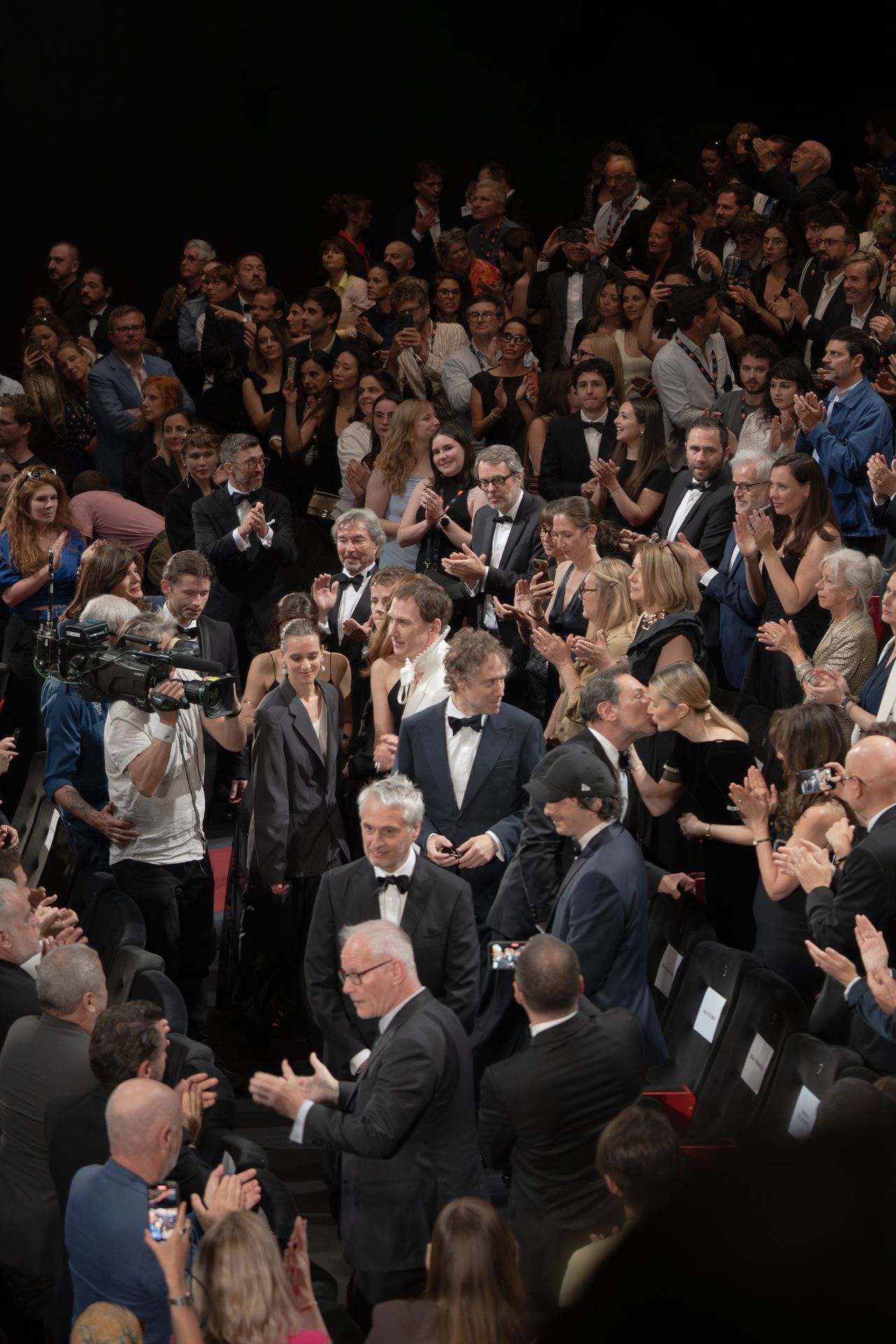
Anyone trying to understand Cannes in 2026 had to look beyond the screening schedule and watch the red carpet as its own parallel event. Associated Press coverage from the festival’s closing stretch emphasized the sheer intensity of the fashion cycle: twelve days of nonstop premieres ending in a final rush of gowns, tuxedos, styling narratives, and visual recaps consumed around the world. This was not a side dish to the festival. It was one of the main products Cannes exported.
That distinction matters because the red carpet now functions independently of the films it supposedly serves. Outlets that barely cover international cinema still cover Cannes fashion obsessively, while social feeds amplify looks, arrivals, and body language faster than any critical assessment of the competition titles. The image economy is immediate, borderless, and algorithmically efficient. A premiere may belong to a director, but a red carpet belongs to the internet.
In 2026, that divide became especially visible because the fashion conversation often outran the film conversation altogether. Vogue’s festival takeaways highlighted how the red carpet remained a site of enormous global visibility for attendees and brand partners. AP, fashion publications, and entertainment outlets all treated Cannes style not as decorative accompaniment but as an editorial main event. Even when coverage acknowledged the films, it frequently framed them through appearance, celebrity presence, or spectacle.
This does not mean the glamour is fake or trivial. Cannes has always fused cinema with self-presentation, and part of its historical appeal lies precisely in that collision between artistic seriousness and theatrical excess. But in earlier decades, the red carpet amplified a film culture that still controlled the festival’s symbolic core. In 2026, the relationship looked more evenly split. In some cases, especially online, it looked reversed.
That reversal changes how Cannes is consumed by the general public. A person can now experience the festival almost entirely through visuals: a designer dress, a viral entrance, a beauty partnership, a paparazzi moment, a hotel balcony shot, a TikTok recap. None of those experiences requires engagement with a single frame of the films in competition. Cannes still produces great cinema headlines, but it also produces a vast stream of luxury-adjacent content that circulates with or without the cinema itself. When that happens at scale, the festival stops being just a cultural event and starts behaving like a media format.
Brands, sponsors, and activations are no longer background noise

If the red carpet became a product, brands became some of its most skilled producers. One of the clearest signs of Cannes’ expanding identity in 2026 was the prominence of sponsor activations and luxury-adjacent experiences that operated in tandem with the official festival. Vogue pointed to Alo’s presence, which included yoga classes and a wellness club during the festival. That detail may sound minor, but it captures a larger truth: Cannes now offers not just premieres and parties, but an entire branded environment.
The ecosystem around the Croisette makes this possible. Official partners and adjacent luxury houses have long used Cannes as a stage, but in 2026 the activations felt more integrated into the event’s cultural surface. Coverage of brand strategy during the festival highlighted how companies such as L’Oréal Paris, Peugeot, and Magnum approached Cannes not simply as a sponsorship opportunity, but as a narrative platform. Their goal was not just logo placement. It was identity transfer: borrowing the language of cinema, glamour, and international prestige to deepen their own relevance.
That evolution matters because it changes who Cannes is for. A traditional festival primarily serves filmmakers, critics, distributors, programmers, and audiences. A modern event platform serves all of those groups plus global advertisers, fashion conglomerates, experiential marketers, publicists, creators, and image consultants. Cannes in 2026 looked increasingly optimized for the second category. The festival still rewards directors, but the surrounding machine is highly valuable to industries that have nothing to do with making films.
There is an important difference between support and substitution. Sponsorship has always helped sustain elite cultural events, and few major festivals operate outside the logic of commerce. The question is not whether brands should be present. The question is whether they are beginning to shape the meaning of the occasion itself. When wellness pop-ups, celebrity ambassador programs, and open-air exhibitions become central to how the festival is experienced, they stop being peripheral.
That does not necessarily degrade Cannes. In fact, one could argue that this hybridity is part of its enduring power. Cannes is where art, capital, status, and aspiration meet in unusually concentrated form. But 2026 suggested that the commercial wrapper is becoming more visible, more sophisticated, and more self-confident. Cannes is still a place where films are launched into the world. It is also a place where brands audition for cultural legitimacy, and increasingly, they know exactly how to steal the scene.
Influencers and creators exposed a shift in who gets to represent culture

Perhaps the most revealing change at Cannes 2026 was not the presence of sponsors or even the dominance of fashion. It was the growing role of creators and influencers in occupying space once reserved for actors, filmmakers, and traditional media. Coverage from marketing and media trade outlets described a notable expansion in how brands approached the festival, moving beyond classic celebrity ambassadors to include creators whose value lies in audience reach, platform fluency, and real-time engagement. That shift may be the clearest sign that Cannes is adapting to a new hierarchy of attention.
The logic is obvious. A star arriving for a premiere still generates press photos, but a creator can turn one invitation into dozens of pieces of content across multiple platforms, each tailored to a different demographic and algorithm. That makes influencers attractive not only to brands but to the entire publicity ecosystem surrounding Cannes. Bloomberg’s commentary on Hollywood’s weaker presence argued that the vacuum created by fewer major U.S. studio events opened more room for influencers to shape the culture around the festival. Even if one thinks that diagnosis is overstated, it captures a real transition.
This is where the question of legitimacy becomes sharper. Cannes has historically functioned as a gatekeeping institution. It tells the film world which works matter, which directors are ascendant, and which performances enter the awards conversation with new force. Influencer culture runs on a different principle. It is less concerned with curation than with circulation, less interested in judgment than in visibility. When those two systems overlap, friction is inevitable.
Yet dismissing creators as intruders misses the deeper reality. They are not at Cannes by accident. They are there because the festival has become part of a broader global attention economy in which cultural significance is measured not only by reviews and prizes, but by shareability, discoverability, and parasocial intimacy. Cannes did not lose control of that economy; it joined it. The festival now benefits from the very dynamics that also threaten to dilute its cinephile identity.
That is why the influencer question is so important. It is tempting to frame it as a conflict between purity and corruption, between serious cinema and shallow digital fame. But Cannes has never been pure. It has always mediated between art and performance, prestige and publicity. What changed in 2026 is that the representatives of publicity no longer looked like old-school entertainment reporters or studio publicists. They looked like creators with ring lights, brand deals, and millions of followers. Whether one sees that as democratization or degradation depends on what one thinks Cannes is supposed to protect.
Cannes is still a film festival, but now it functions as a cultural super-platform

So what, finally, was Cannes in 2026? The most persuasive answer is not that it stopped being a film festival. It is that it outgrew that label without fully replacing it. The competition remained serious, the jury structure remained central, and the festival’s institutional commitment to cinema was visible everywhere from the official selection to the parallel sections and market infrastructure. If Cannes were merely a fashion week with screenings attached, the auteur-heavy 2026 lineup would have looked very different.
At the same time, it would be naïve to pretend that film alone explains Cannes anymore. The event now operates as a cultural super-platform where cinema is the core asset but not the only one. It is a marketplace, branding arena, tourism engine, image factory, influencer summit, status ritual, and luxury showcase. Each of those functions feeds the others. The films give Cannes legitimacy. The glamour gives it scale. The brands give it money. The creators give it reach. The market gives it industry muscle.
That hybrid model may actually be why Cannes remains so resilient. In a fragmented media landscape, institutions that rely on one form of authority alone are vulnerable. Cannes survives because it speaks fluently to several audiences at once: cinephiles, executives, fashion houses, journalists, creators, and the global public that may never watch the Palme d’Or winner but still knows Cannes signifies taste and importance. In 2026, the festival’s power came precisely from that layered identity.
But there is a cost to becoming everything. The more Cannes expands as spectacle, the more it risks making cinema feel like one premium content vertical among many. That would be a genuine loss, not because glamour and commerce do not belong there, but because Cannes’ highest value lies in its ability to force the world to pay attention to film as art. If that mission becomes secondary, the festival may remain powerful while becoming conceptually hollow.
The real lesson of Cannes 2026, then, is not that the festival has ceased to be itself. It is that “itself” has become far more complicated. Cannes is still a film festival. It is also an attention machine sophisticated enough to turn every premiere, face, dress, yacht, sponsor lounge, and social post into part of the same global performance. The question is no longer whether Cannes has changed. The question is whether cinema can continue to dominate the stage that still bears its name.