

The Apollo era still has the power to surprise. More than 56 years after Apollo 12 flew to the moon, newly resurfaced government files have reignited debate over one of the mission’s strangest moments.
Why Apollo 12 is back in the headlines
The immediate trigger for the renewed attention is a May 2026 Pentagon release of declassified UFO and UAP-related files. According to AP and Space, the first tranche included well over 150 records, among them older NASA transcripts, debriefings, and lunar photographs tied to Gemini, Apollo, and Skylab missions. Apollo 12 drew particular interest because several of the released materials focused on comments by astronauts describing unusual lights and visual anomalies during the 1969 flight.
That framing has led some readers to believe the public is seeing a hidden Apollo secret for the first time. In reality, the core Apollo 12 mission records have been publicly accessible for decades through NASA archives and mission history collections. What changed in 2026 was not the existence of the material but its repackaging inside a Pentagon declassification effort, where old NASA documents were presented alongside unresolved military UAP cases. That shift in context dramatically altered how the public interpreted them.
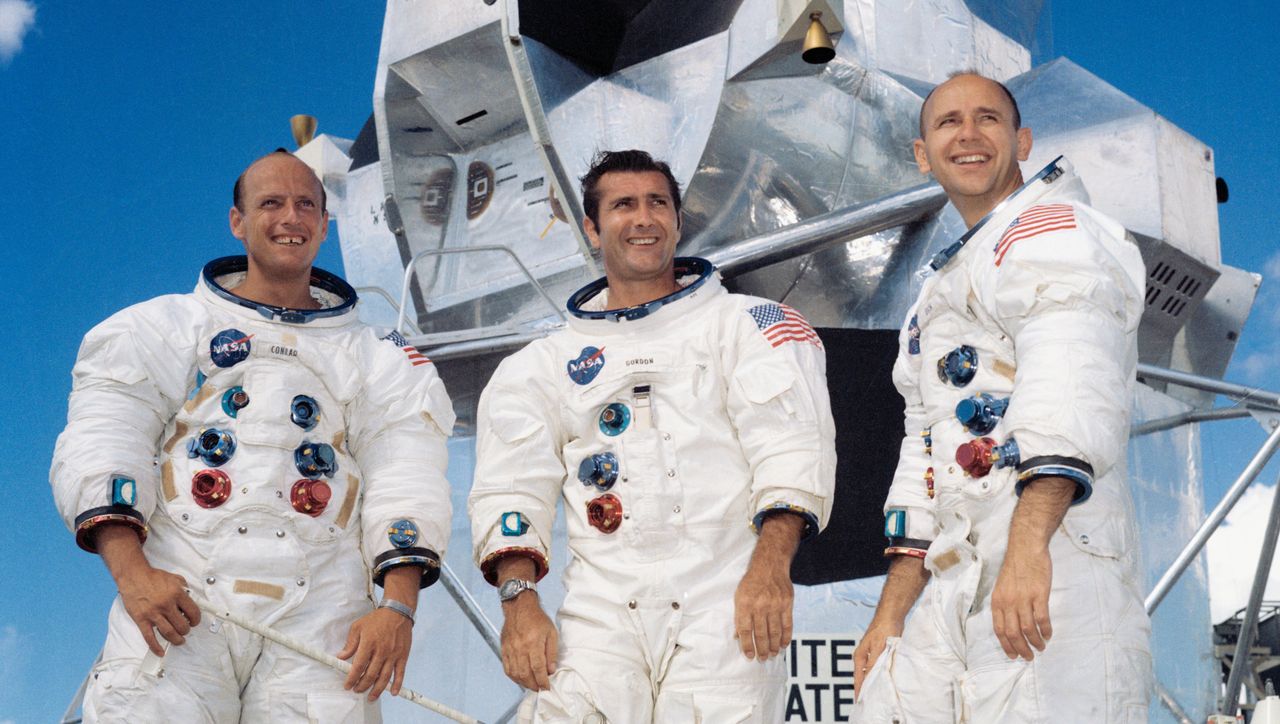
Apollo 12 itself was already one of NASA’s most dramatic moon missions. Launched on November 14, 1969, it became the second crewed lunar landing mission, carrying Charles “Pete” Conrad Jr., Alan L. Bean, and Richard F. Gordon Jr. The flight is famous for being struck by lightning twice shortly after liftoff and then recovering to complete a precise landing in the Ocean of Storms on November 19, 1969. NASA still presents it as the “pinpoint mission” because of the accuracy of that landing and the major scientific work that followed.
The “mysterious lights” story has persisted because it sits at the uncomfortable border between space history and modern UAP culture. The astronauts unquestionably discussed visual phenomena. The surviving transcripts and debrief records show that they noticed flashes, particles, and lights during different phases of flight. But the documents do not prove extraterrestrial activity, and neither NASA nor the Pentagon has offered such a conclusion. The enduring fascination comes from the combination of authentic astronaut testimony, ambiguous imagery, and a modern public newly primed to see every unexplained object through the lens of disclosure.
What the astronauts actually reported

The most widely repeated Apollo 12 remarks are tied to Alan Bean’s observations while looking through the lunar module’s alignment optical telescope, a narrow-view instrument used for orientation and navigation. As summarized by Live Science from the mission transcript, Bean described seeing “particles of light” and “flashes of light” “sailing off in space.” He also remarked that some of the objects seemed to be “escaping the moon” and moving rapidly against the star field. Those phrases are vivid enough that they continue to circulate widely in headlines and social media discussions.
Other Apollo-era records show that astronauts were no strangers to unusual visual effects. AP noted that a 1969 Apollo 11 debrief included Buzz Aldrin discussing a “fairly bright light source,” while the broader 2026 Pentagon release grouped such reports together as unresolved observations. That matters because Apollo 12 was not unique in producing hard-to-categorize comments; it was part of a wider pattern of crews describing flashes, glints, and moving points of light in an environment where normal visual references were scarce and spacecraft systems could create misleading cues.
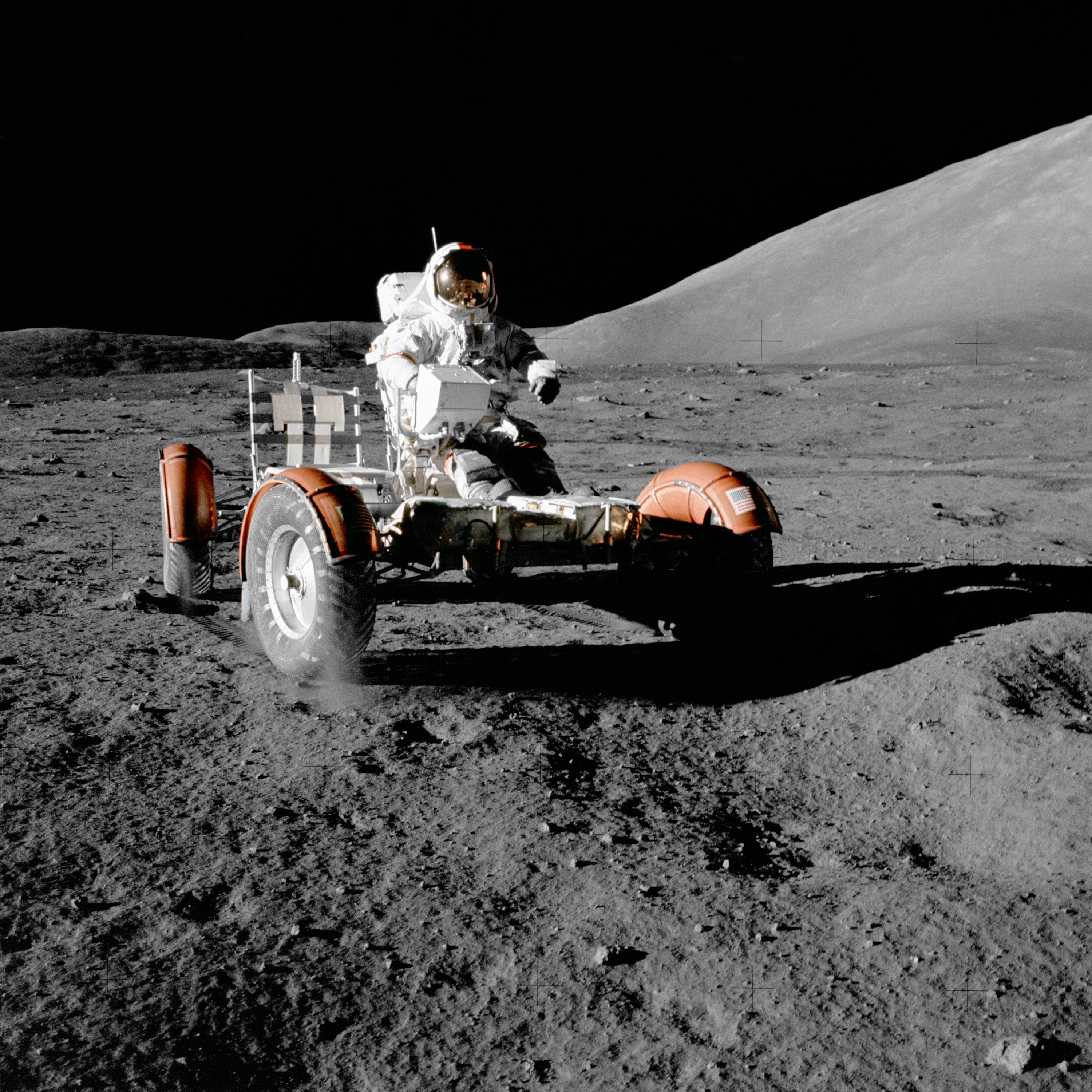
Apollo 12 also generated renewed interest because of lunar-surface photographs highlighted in the 2026 release. Space reported that one Apollo 12 image was presented with five marked regions above the horizon where unidentified features were visible. The images themselves were not newly discovered, but the annotations suggested that somebody within government had considered the visual anomalies worthy of special attention. That alone was enough to fuel speculation that NASA had quietly flagged unexplained phenomena during the mission.
Yet the language of the original records remains more cautious than many viral retellings suggest. The crew was describing what they perceived in real time, not issuing a formal claim about alien craft or unknown technology. In spaceflight operations, this distinction is crucial. Astronauts are trained observers, but they are still human beings operating in unusual lighting, inside complex machines, often tired, task-saturated, and interpreting fleeting visual events through windows, optics, and instruments never designed for paranormal certainty. That is why the transcripts are historically important even when they are not definitive.
The most likely explanations for the lights

The strongest explanations are grounded in ordinary spaceflight physics. Tiny particles shed by a spacecraft, vented materials, ice crystals, insulation fragments, or debris illuminated by the sun can appear startlingly bright against black space. In some Apollo discussions summarized in later archive material, observers connected certain lights to small bits and pieces floating alongside the vehicle or to reflections associated with tracking lights and spacecraft systems. In other words, at least some “mystery” objects may have been local to the spacecraft rather than distant unknown craft.
Radiation offers another credible explanation. Astronauts have long reported flashes of light with their eyes closed during missions beyond low Earth orbit, a phenomenon often associated with cosmic rays interacting with the visual system. AP’s reporting on the 2026 document release noted that Apollo 11 astronauts also discussed flashes inside the cabin, which were interpreted as possible penetrations or static-like effects. Once that broader context is considered, Apollo 12’s reports fit into a known class of unusual but not necessarily extraordinary sensory experiences in deep space.
Photography complicates matters further. Bright points in Apollo images can be caused by lens flare, film artifacts, internal reflections, scanning defects, overexposure, or dust and scratches introduced during handling and reproduction. Space specifically emphasized that many of the images now touted as “revealed” had been public for decades. The 2026 versions simply highlighted certain regions, which can create the impression of a stronger mystery than the raw original material supports. In visual analysis, annotation can be powerful, but it is not the same thing as explanation.
Even the astronauts entertained conventional possibilities. Live Science reported that mission control raised electromagnetic interference as one possible cause of some of the strange flashes, and the crew agreed that this was plausible. That exchange is revealing because it shows NASA was treating the observations as operational anomalies to be interpreted, not as evidence of something supernatural. The unresolved status of the case owes more to limited data quality than to the strength of any extraordinary hypothesis.
Why declassification changes perception without changing the facts

Declassification has immense symbolic force. When the Pentagon places old records inside a modern UAP archive, many readers infer that the documents were once suppressed because they contain explosive truths. But the Apollo 12 case shows how declassification can change perception more than substance. Space reported plainly that these Apollo materials had been public for decades, despite fresh headlines describing them as revelations. The public reaction says as much about today’s disclosure culture as it does about the mission itself.
That context matters because the 2026 release blended very different kinds of material into one narrative stream. AP described the archive as including old State Department cables, FBI reports, NASA transcripts, and modern military sensor cases. Those categories are not equivalent. A pilot report over Kazakhstan, a drone operator statement, and a 1969 astronaut observation from lunar flight may all be “unresolved” in bureaucratic terms, but they arise from different technologies, standards of evidence, and investigative goals. Putting them together encourages comparison, even when direct comparison is shaky.
The Apollo 12 story also illustrates a recurring problem in the digital age: archival documents can be both authentic and misunderstood. A real transcript carries obvious authority, especially when astronauts are speaking plainly and descriptively. Yet authenticity does not automatically settle interpretation. The same set of words can support a mundane reading, a sensational reading, or an agnostic one depending on who is presenting it. When highlighted images, dramatic headlines, and the term “declassified” enter the mix, the most exotic reading often wins the first round of public attention.
For historians and science writers, the better question is not whether Apollo 12 “proved UFOs,” because it did not. The better question is why ambiguous evidence remains so culturally powerful. Part of the answer is that the Apollo missions occupy a unique place in human imagination: they were technically rigorous, emotionally resonant, and conducted in an environment so alien that normal intuition frequently fails. When astronauts say they saw something odd near the moon, people listen, and they should. But listening carefully means preserving uncertainty instead of filling it with certainty we do not actually possess.
What Apollo 12 still teaches us today

Apollo 12 remains a superb case study in how serious observers handle uncertainty. The astronauts were credible, technically trained witnesses. NASA documented their mission in exhaustive detail. And yet, more than half a century later, some of what they saw still cannot be pinned down with precision. That does not make the case evidence of extraterrestrial visitation. It makes it evidence that human observation, even at the highest level, has limits when events are brief, conditions are unusual, and instrumentation is imperfect.
The renewed attention may still have value. Public interest in these records can encourage closer reading of NASA archives and a healthier appreciation for how spaceflight really works. Apollo missions were not clean cinematic journeys through a perfectly understood void. They were technically messy operations involving glare, debris, radiation, optics, fatigue, and constant interpretation under pressure. If the 2026 file release pushes more readers toward that reality, it will have done something useful beyond fueling speculation.
It also underscores the importance of evidence standards in today’s UAP debate. Modern audiences often conflate “unidentified” with “unexplainable,” and “declassified” with “suppressed truth.” Apollo 12 reminds us that an unresolved observation can be genuine, important, and still unspectacular in the final analysis. Sometimes a light is unidentified because the record is incomplete, not because the phenomenon defies physics. That distinction is easy to lose in a media environment built for drama.
In the end, Apollo 12’s strange lights endure because they capture something timeless about exploration. Venturing into new environments produces real anomalies, honest wonder, and occasional confusion. The astronauts reported what they saw. The records survived. The mystery remains partly open, but not because it points cleanly to aliens. It remains open because space is a hard place to observe from, and history is often stranger, subtler, and more interesting than the loudest headline first suggests.